For many Indian businesses, digital marketing has become synonymous with one thing:
Social media.
Post regularly.
Make Reels.
Upload festival creatives.
Get followers.
Run an occasional ad.
And when business growth doesn’t follow, the conclusion is often: “Digital marketing kaam nahi kar raha.”
But that’s not necessarily the problem.
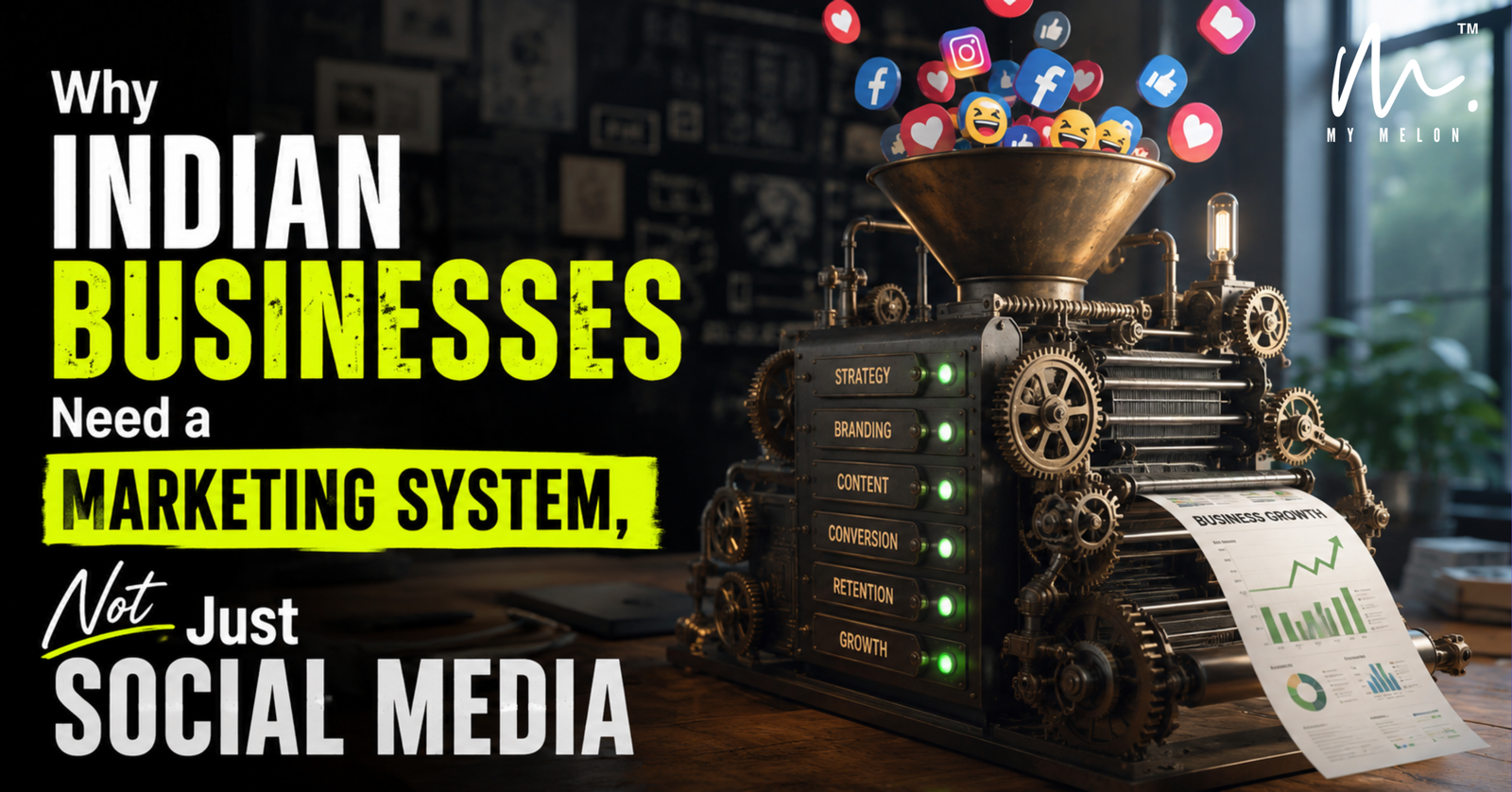
The real problem may be that there was never a marketing system in the first place.
Social media is a channel. It is not a complete growth strategy.
A business can have 20,000 followers and still struggle to generate enquiries. Another business can have a relatively small following but consistently generate customers through Google, its website, content, referrals, advertising, and remarketing.
The difference isn’t always the size of the audience.
It’s the system behind the marketing.
For Indian businesses competing in increasingly crowded markets, building that system is becoming less of an advantage and more of a necessity.
Social Media Is Important. But It Isn’t the Whole Game.
Let’s be clear.
Social media matters.
Platforms such as Instagram, Facebook, LinkedIn, and YouTube can help businesses:
- Build awareness
- Showcase products
- Educate customers
- Build communities
- Humanize the brand
- Generate demand
- Retarget potential customers
The mistake is treating social media as the entire marketing engine.
Imagine a business that posts three times every week.
The content looks good.
Engagement is decent.
But when someone searches for the company on Google, the website looks outdated.
When they search for the service, the company doesn’t appear.
There are few reviews.
There are no detailed case studies.
The landing page doesn’t explain the offering clearly.
And there is no process to follow up with people who showed interest.
The business has social media.
But it doesn’t have a marketing system.
What Is a Marketing System?
A marketing system is a connected set of channels, processes, content, and measurement mechanisms that move someone from:
Awareness → Interest → Consideration → Enquiry → Conversion → Retention
Instead of asking: “What should we post this week?”
You start asking: “How are potential customers discovering us, evaluating us, contacting us, and eventually choosing us?”
That’s a fundamentally different approach
The Indian Customer Journey Has Changed
Indian consumers and business buyers are more digitally informed than ever.
Before making a purchase or contacting a company, they may:
- Search Google
- Check Google Maps
- Read reviews
- Visit the website
- Compare competitors
- Browse Instagram
- Check LinkedIn
- Watch YouTube videos
- Search for pricing
- Ask for recommendations
This means your brand needs to exist across multiple touchpoints.
A potential customer may discover you through Google and then check Instagram.
Another may see your Reel and later search your brand name.
A B2B buyer may find your company through LinkedIn and then spend 10 minutes reading your website.
Marketing doesn’t happen on one platform anymore.
The 7 Components of a Strong Marketing System
A practical marketing system can be built around seven major components.
1. Website: Your Digital Home
Your social media profiles belong to platforms you don’t control.
Your website is different.
It is where you can control:
- Brand positioning
- Messaging
- Product information
- Case studies
- Customer journeys
- Lead capture
- Conversion paths
A good website should answer three questions quickly:
What do you offer?
Why should I trust you?
What should I do next?
For a B2B company, this could mean requesting a quote.
For a clinic, booking an appointment.
For a real estate company, scheduling a site visit.
For an e-commerce brand, purchasing a product.
Your website shouldn’t simply look good.
It should move people toward a business outcome.
2. SEO: Be Present When People Are Looking
Social media creates discovery.
Search captures existing intent.
That’s a major distinction.
Someone scrolling Instagram may not be looking for your service.
Someone searching: “digital marketing agency in Delhi” already has a problem they want to solve.
Similarly: “best dental clinic near me”, “industrial packaging manufacturer”, “commercial interior designer Gurgaon”, “accounting services for startups” These searches represent intent.
SEO helps your business become visible at precisely that moment.
3. Content: Build Authority Before the Sales Conversation
Content shouldn’t exist simply because your social media calendar says you need three posts this week.
Every piece of content should have a purpose.
It can:
- Answer a question
- Solve a problem
- Demonstrate expertise
- Address an objection
- Compare alternatives
- Explain a product
- Build trust
For example, a manufacturing company could publish:
“How to Choose the Right Industrial Packaging for Export Products”
A healthcare business could publish:
“When Should You See a Physiotherapist for Back Pain?”
A digital marketing agency could publish:
“Why Your Website Gets Traffic but Doesn’t Generate Leads”
This content can then be distributed through:
- Search
- Social media
- Sales conversations
One useful piece of content can work across multiple channels.
4. Social Media: The Brand’s Public Personality
Now we come back to social media.
Its role becomes much clearer.
Social media should help people:
Discover → Remember → Trust → Engage
Instead of posting random content, create content around different objectives.
Awareness Content
Helps new people discover the brand.
Educational Content
Demonstrates expertise.
Proof Content
Shows customers, projects, results, reviews, and testimonials.
Brand Content
Shows the people and values behind the business.
Conversion Content
Gives interested prospects a clear next step.
This creates a healthier content mix than simply publishing promotional creatives every day.
5. Paid Marketing: Accelerate What Already Works
Paid advertising can provide speed.
SEO may take time.
Organic social media may take time.
Paid campaigns can put your offer in front of relevant audiences much faster.
But advertising shouldn’t operate independently.
Suppose someone clicks your ad and lands on a weak website.
You paid to bring them there.
Then you lose them.
A stronger system connects:
Ad → Landing Page → Proof → Enquiry → Follow-up → Conversion
That’s why increasing ad spend doesn’t automatically solve a marketing problem.
If the system underneath is broken, scaling the ad budget simply scales the waste.
6. Retargeting: Don’t Forget People Who Already Showed Interest
This is one of the most overlooked components of marketing.
Not everyone converts the first time they encounter your brand.
Someone might:
- Visit your website
- Watch your video
- View a product
- Engage with your Instagram page
- Click an advertisement
and leave.
That doesn’t mean they aren’t interested.
Retargeting allows businesses to reconnect with people who have already interacted with the brand.
For example:
First interaction
A person watches a video about your service.
Second interaction
They see a case study.
Third interaction
They see a customer testimonial.
Fourth interaction
They receive an offer to book a consultation.
That’s a journey.
Not a single advertisement.
7. Measurement: Know What’s Actually Driving Growth
A marketing system without measurement is just activity.
Businesses should know:
- Where leads are coming from
- Which campaigns generate qualified enquiries
- Which landing pages convert
- Which keywords attract relevant traffic
- Which content drives engagement
- Which channels generate revenue
- How much it costs to acquire a customer
And most importantly:
Which marketing activities actually contribute to business growth?
Likes don’t answer that question.
Followers don’t answer it either.
Revenue, qualified leads, conversion rate, customer acquisition cost, and retention provide much more useful information.
The Biggest Problem With “Post More”
One of the most common marketing recommendations businesses receive is: “Aapko social media pe consistently post karna chahiye.” Consistency is important.
But consistency without strategy can become a trap.
You can consistently publish content that:
- Nobody searches for
- Nobody cares about
- Doesn’t differentiate your business
- Doesn’t build trust
- Doesn’t generate enquiries
And after six months, you have a beautiful content archive but little business impact.
Consistency amplifies strategy. It doesn’t replace it.
Your Channels Should Work Together
A strong marketing system creates connections between channels.
For example:
SEO
Brings someone to your website.
↓
Website
Explains your expertise.
↓
Content
Builds trust.
↓
Social Media
Keeps your brand familiar.
↓
Retargeting
Brings the prospect back.
↓
Lead Form / WhatsApp / Call
Creates the conversation.
↓
Sales Team
Converts the opportunity.
↓
CRM / Follow-up
Helps close and retain the customer.
That’s a system.
Why This Matters Even More for Indian SMEs
India has thousands of businesses competing within almost every category.
You may be an excellent:
- Manufacturer
- Healthcare provider
- Real estate company
- Education brand
- Professional service
- Retailer
- D2C business
But being good doesn’t guarantee being discovered.
Your competitor may have:
- Better SEO
- Better website
- Better reviews
- Better content
- Better positioning
- Faster follow-up
They don’t necessarily have a better product.
They may simply have a better customer acquisition system.
Marketing Should Reduce Dependency on One Channel
Imagine a business gets almost every new customer through referrals.
That’s valuable.
But it’s also risky.
What happens when referrals slow down?
Similarly, if a business depends entirely on Instagram:
What happens if reach drops?
If it depends only on paid ads:
What happens when acquisition costs increase?
If it depends only on exhibitions:
What happens between events?
A diversified marketing system creates multiple paths to growth.
You don’t need every channel.
You need the right combination for your business.
What Should a Business’s Marketing System Look Like?
There is no universal formula.
A local healthcare clinic may need:
Local SEO + Google Business Profile + Website + Reviews + Google Ads + Content
A manufacturing company may need:
SEO + Website + LinkedIn + Content + Case Studies + Google Ads
A D2C brand may need:
Social + Paid Ads + Influencers + Website + Email + Retargeting
A B2B service company may need:
LinkedIn + Founder Branding + SEO + Website + Content + CRM
The point isn’t to be everywhere.
The point is to identify:
Where your customers are → what they need → how they make decisions → what moves them toward purchase.
How to Build a Marketing System Step by Step
Step 1: Define Your Ideal Customer
Don’t start with Instagram.
Start with the customer.
Understand:
- Who they are
- What problem they have
- What triggers their search
- What alternatives they consider
- What objections they have
- What makes them trust a business
Step 2: Map the Customer Journey
Ask:
Where do they discover us?
Where do they research us?
Where do they compare us?
Where do they contact us?
What makes them convert?
This identifies gaps in your current marketing.
Step 3: Fix the Foundation
Before increasing traffic, make sure you have:
- Strong website
- Clear positioning
- Conversion paths
- Reviews
- Proof
- Analytics
Don’t pour traffic into a broken funnel.
Step 4: Choose Your Core Channels
Don’t blindly use every platform.
Choose channels based on customer behaviour.
Search-heavy business?
Prioritize SEO and Google Ads.
B2B?
Consider LinkedIn, SEO, content, and founder-led marketing.
Visual consumer brand?
Social and creator marketing may matter more.
Step 5: Create Content With a Purpose
Build content around:
- Problems
- Questions
- Objections
- Use cases
- Expertise
- Proof
Then distribute that content across relevant channels.
Step 6: Add Paid Acquisition
Once the foundation is ready, use paid marketing to accelerate demand.
But measure:
Qualified leads, not just clicks.
Step 7: Build Follow-Up
This is where many businesses lose money.
Generating an enquiry is not the same as generating a customer.
Have a process for:
- Responding quickly
- Qualifying leads
- Following up
- Handling objections
- Tracking conversations
Marketing and sales need to work together.
The Difference Between Marketing Activity and Marketing
This distinction matters.
Marketing activity:
“We posted 20 times this month.”
Marketing:
“Organic search generated 35 qualified enquiries and our content contributed to 12 of them.”
Marketing activity:
“Our Reel got 50,000 views.”
Marketing:
“That campaign generated 80 relevant enquiries and 15 customers.”
Marketing activity:
“We gained 2,000 followers.”
Marketing:
“Our brand searches and direct enquiries increased.”
The second category is what businesses should care about.
Final Thoughts
Social media isn’t dead.
It isn’t irrelevant.
And businesses absolutely should use it when it makes sense.
But social media alone isn’t a marketing strategy.
A modern business needs an interconnected system where:
Content builds authority.
Social media builds familiarity.
SEO captures intent.
The website builds trust and converts.
Paid campaigns accelerate reach.
Retargeting brings prospects back.
Sales converts opportunities.
Analytics tells you what deserves more investment.
When these pieces work together, marketing stops being a collection of disconnected activities and becomes a business growth system.
The goal isn’t to simply “do digital marketing.”
The goal is to build a system that consistently helps the right people discover you, trust you, choose you, and come back to you.
How MyMelon Helps Businesses Build a Marketing System
At MyMelon, we believe businesses need more than a social media calendar.
We help businesses build a structured digital marketing ecosystem around their actual growth goals.
That can include:
Website + SEO + Content + Social Media + Performance Marketing + ORM + Analytics
The exact combination depends on the business, its market, and where its customers actually make decisions.
Because the objective isn’t to be active on every platform.
It’s to make your marketing work together.
If your business is posting consistently but still struggling with visibility, enquiries, or predictable growth, the answer may not be “post more.”
You may simply need a better system.