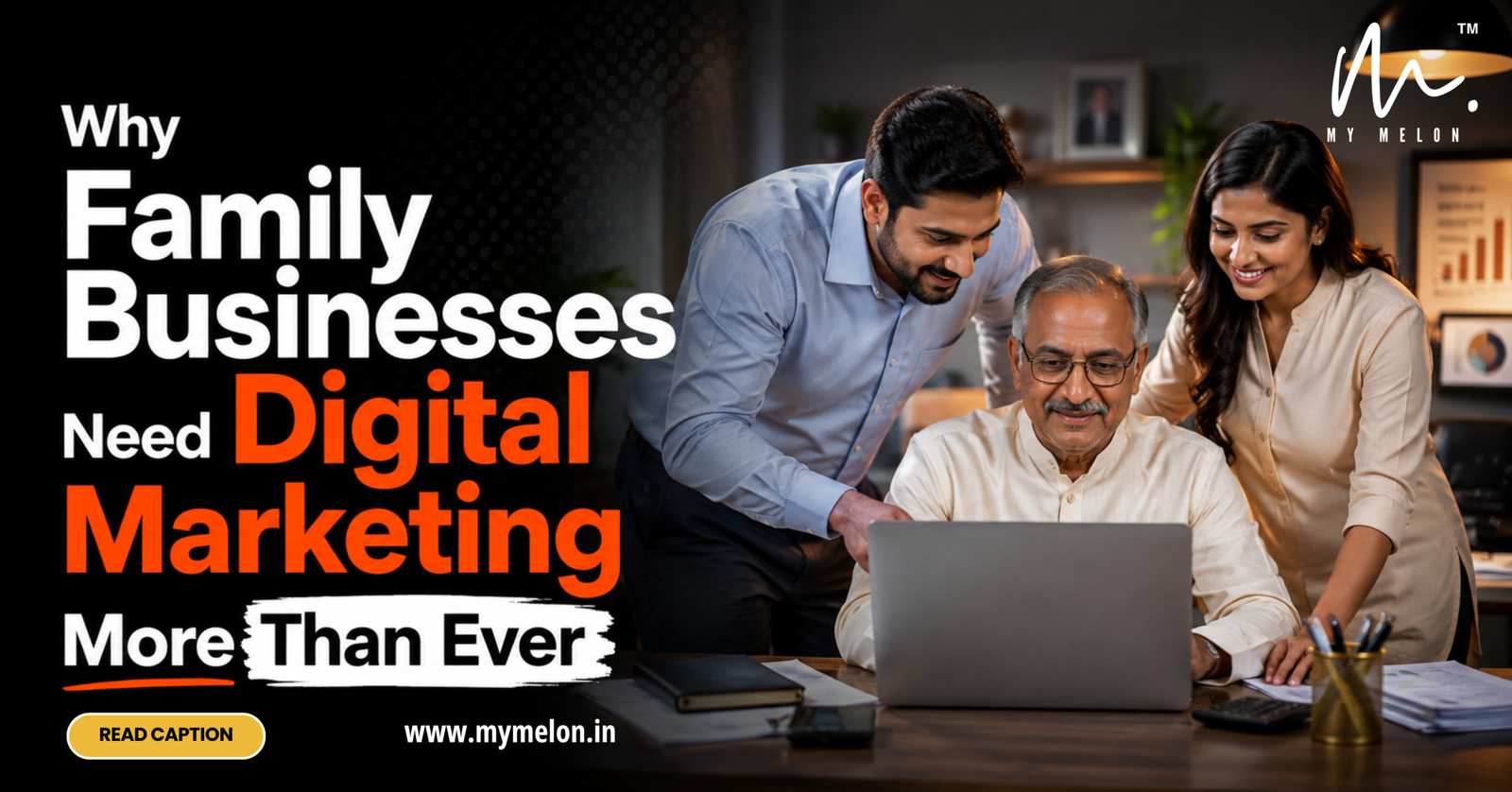
Family businesses have something most modern brands spend years trying to build: trust.
A family name, decades of experience, loyal customers, strong supplier relationships, and a reputation built over generations can be incredibly powerful.
But there is a problem.
The way customers discover businesses has changed.
A business may have been operating successfully for 20, 30, or even 50 years, but a new customer today may have no idea it exists.
They search on Google.
They check the website.
They look at reviews.
They explore social media.
They compare competitors.
And only then do they decide whom to contact.
This creates an interesting situation for family businesses.
You may have 50 years of offline credibility, but if a customer cannot find you online, your competitor with five years of experience can still get the enquiry.
That is why digital marketing is no longer just for startups, D2C brands, or technology companies.
For family businesses, it has become a way to protect existing reputation, reach the next generation of customers, and build a business that can continue growing beyond personal relationships.
The Biggest Advantage Family Businesses Already Have
Before talking about digital marketing, there is something important to understand.
Family businesses are not starting from zero.
They already have assets that many new businesses struggle to create:
- Brand history
- Customer relationships
- Industry expertise
- Word-of-mouth reputation
- Repeat customers
- Supplier relationships
- Product knowledge
- Real-world experience
The problem is that many of these assets remain offline.
Your customers know you.
Your suppliers know you.
People in your industry know you.
But what happens when someone outside your existing network searches for your product?
That is where the gap begins.
The New Customer Doesn’t Know Your History
Imagine two companies.
Company A
- 30 years in business
- Strong customer relationships
- Experienced team
- Excellent products
- Almost no digital presence
Company B
- 7 years in business
- Smaller operation
- Less industry experience
- Professional website
- Strong Google presence
- Active LinkedIn profile
- Consistent content
- Positive reviews
A potential customer searches for the product online.
Company B appears everywhere.
Company A barely appears.
Who do you think the customer is more likely to trust?
This is one of the biggest challenges family businesses face today.
Experience creates credibility, but visibility allows people to discover that credibility.
Digital Marketing Is Not About Becoming “Trendy”
One misconception among established businesses is that digital marketing means:
- Posting Instagram Reels
- Following trends
- Making memes
- Chasing followers
- Going viral
That’s not what a serious digital strategy should look like.
For a family business, digital marketing should answer a much more important question: How do we make our existing reputation visible to people who don’t know us yet?
That requires a structured approach.
1. Turn Your Legacy Into a Digital Asset
Your history is valuable.
But simply writing:
“Serving customers since 1985”
isn’t enough.
Your history should become part of your digital storytelling.
For example, a family business can showcase:
- How the company started
- Why the founder started it
- Major milestones
- How products or services evolved
- Generational transition
- Important customer relationships
- Industry expertise
- Major projects
- Manufacturing capabilities
This transforms history from a sentence on the “About Us” page into a brand asset.
2. Build a Website That Reflects the Business You Actually Are
Many established family businesses have websites that haven’t evolved with the business.
The website might contain:
- Old photographs
- Outdated product information
- Basic company history
- A phone number
- A generic contact form
That’s not enough.
Your website should communicate the scale and credibility of the business.
A strong website should showcase:
Your story
Why did the business start?
Your expertise
What do you know better than competitors?
Your products and services
What exactly do you offer?
Your proof
Who have you worked with?
What projects have you completed?
Your people
Who runs the business today?
Your capabilities
What can you deliver?
Your locations
Where do you operate?
The website should make a potential customer think: “These people know what they’re doing.”
3. Google Is the New Business Directory
For decades, family businesses benefited from local reputation.
People would ask: “Best supplier kaun hai?”
Someone would recommend a company.
Today, many people simply search.
For example:
- “best furniture manufacturer in Delhi”
- “industrial supplier near me”
- “family-owned jewellery business Delhi”
- “packaging manufacturer in Gurgaon”
- “office furniture dealer near me”
If your business doesn’t appear when these searches happen, your reputation cannot help you.
This is where SEO and Local SEO become important.
4. Local SEO Can Turn Reputation Into Visibility
Family businesses often have a strong presence in their local market.
Digital marketing can amplify it.
Start with your Google Business Profile.
Make sure you have:
- Accurate business information
- Correct address
- Updated phone number
- Business hours
- High-quality photographs
- Product/service information
- Regular updates
- Customer reviews
And most importantly, keep the profile active.
A strong local presence can help convert searches into:
- Phone calls
- Website visits
- Directions
- WhatsApp conversations
- Store visits
5. Your Customer Reviews Are Digital Word-of-Mouth
Family businesses have traditionally grown through word-of-mouth.
Digital reviews are essentially the modern version of it.
Think about the difference:
Traditional
“Mere friend ne bola tha ye company achhi hai.”
Digital
“They have 4.8 stars and hundreds of reviews.”
Both create trust.
But the second one is visible to thousands of potential customers.
Encourage genuine customers to share their experiences and respond professionally to reviews.
Don’t manufacture reviews.
Real reputation is more powerful than artificial reputation.
6. The Next Generation of Customers Is Searching Differently
This is perhaps the most important reason family businesses need to modernize.
The next generation of customers doesn’t necessarily have the same relationships your current customers have.
Your existing customers may know the family personally.
Their children may not.
A younger buyer might discover your business through:
- YouTube
- Online reviews
- Your website
This doesn’t mean traditional relationships are becoming irrelevant.
It means you need another bridge between your business and the next generation.
7. LinkedIn Can Be Powerful for Family-Owned B2B Businesses
For B2B family businesses, LinkedIn is particularly valuable.
Instead of only posting: “We provide high-quality products.”
Talk about what you actually know.
For example:
- Industry trends
- Manufacturing challenges
- Procurement insights
- Common customer mistakes
- Product education
- Industry regulations
- Business lessons
- Company milestones
The second generation can also build a professional presence around the family business.
This creates something powerful:
The business becomes associated with people, expertise, and credibility rather than just a company name.
8. Don’t Hide the Family Story
One mistake some family businesses make is trying to look overly corporate.
They remove the personality that actually makes them different.
But your family story can be an advantage.
If three generations have been involved in the business, tell people.
If the founder started with a small workshop, tell people.
If the company survived difficult economic periods, tell people.
If the second generation modernized the business, tell people.
These stories create emotional differentiation.
Large corporations often spend millions trying to manufacture authenticity.
Family businesses already have it.
Use it.
9. Content Marketing Can Demonstrate Decades of Expertise
A family business with decades of experience has an enormous amount of knowledge.
Turn that knowledge into content.
For example, instead of: “We are India’s leading manufacturer.”
Create content such as:
“5 Mistakes Businesses Make When Choosing Industrial Packaging”
or:
“How to Choose the Right Office Furniture for a Growing Company”
or:
“What We Learned From 30 Years in the Manufacturing Industry”
This type of content demonstrates expertise without constantly selling.
And when potential customers eventually need your product or service, your company is already familiar to them.
10. Video Can Bring the Family Behind the Business to Life
People connect with people.
A family business has a natural advantage here.
You don’t necessarily need highly produced corporate videos.
Simple videos can work:
- Founder stories
- Factory tours
- Product demonstrations
- Behind-the-scenes videos
- Customer stories
- Industry insights
- “What we’ve learned” videos
- Generational business stories
The goal isn’t entertainment.
The goal is familiarity and trust.
11. Paid Advertising Can Expand Beyond Your Existing Network
Traditional marketing often limits family businesses to their existing geographic or relationship network.
Digital advertising changes that.
You can target:
- Specific cities
- Industries
- Job roles
- Business decision-makers
- Demographics
- Customer interests
- Search intent
For example, a B2B manufacturer can target decision-makers in specific industrial regions rather than relying entirely on referrals.
A local retailer can target people within a specific radius.
A professional service business can reach potential clients in new markets.
The important point is that advertising should not replace your reputation.
It should put your reputation in front of more relevant people.
12. Don’t Make Social Media Your Entire Marketing Strategy
This is where many businesses get confused.
They start posting regularly and assume they are doing digital marketing.
But social media is only one part of the system.
A stronger digital presence combines:
Website
Your central digital property.
SEO
Helps people discover you through search.
Local SEO
Builds visibility in your target market.
Social Media
Builds familiarity and engagement.
Content
Demonstrates expertise.
Paid Advertising
Accelerates reach and demand generation.
Reviews
Builds social proof.
Analytics
Shows what is actually working.
These channels should work together.
13. Digital Marketing Can Reduce Dependency on Referrals
Referrals are valuable.
You shouldn’t stop them.
The problem is depending only on them.
Imagine your business generates:
100% of new business from referrals.
That’s a vulnerability.
Now imagine referrals remain strong, but you also generate enquiries through:
- Website
- Content
- Paid campaigns
Your acquisition system becomes more diversified.
That means your business isn’t dependent on one source of growth.
14. Digital Marketing Can Help Family Businesses Enter New Markets
This is one of the biggest opportunities.
Traditionally, entering a new market meant:
- Hiring salespeople
- Travelling
- Attending exhibitions
- Finding distributors
- Building relationships
These things still matter.
But digital marketing can help you establish awareness before entering the market physically.
You can:
- Build location-specific landing pages
- Run search campaigns
- Publish market-specific content
- Target decision-makers
- Build local search visibility
- Generate enquiries
Instead of entering a market completely unknown, you can start with an existing digital footprint.
15. The Goal Is Not More Followers. It’s More Business.
Family businesses shouldn’t measure digital success only through:
- Followers
- Likes
- Views
- Comments
These numbers can be useful, but they don’t necessarily represent business growth.
Instead, track:
- Qualified enquiries
- Calls
- Website conversions
- Appointment bookings
- Store visits
- Quote requests
- Cost per qualified lead
- Revenue generated
The question should always be: Is our digital presence helping the business grow?
Common Digital Marketing Mistakes Family Businesses Make
1. We’ve been doing business for 30 years. We don’t need marketing.
Your experience is an advantage.
But it doesn’t automatically create online visibility.
2. Our customers come through references.
Great.
But what happens when you want to reach customers outside your existing network?
3. We have a website.
Having a website isn’t the same as having a good digital presence.
If nobody finds it or trusts it, its existence doesn’t matter.
4. We post on Instagram.
Posting isn’t a strategy.
Your content should have a purpose.
5. Digital marketing is only for young brands.
Actually, established businesses often have more assets to leverage.
They have:
- History
- Customers
- Testimonials
- Expertise
- Case studies
- Brand recognition
Digital marketing simply helps bring these assets online.
The Family Business Digital Transformation Framework
A practical approach can be divided into five stages.
Stage 1: Establish Your Foundation
Build or improve:
- Website
- Google Business Profile
- Social profiles
- Analytics
- Brand messaging
Stage 2: Make Yourself Discoverable
Focus on:
- SEO
- Local SEO
- Search visibility
- Location pages
- Product/service pages
Stage 3: Build Authority
Publish:
- Educational content
- Case studies
- Industry insights
- Founder content
- Videos
Stage 4: Accelerate Growth
Use:
- Google Ads
- Meta Ads
- LinkedIn campaigns
- Retargeting
based on your business goals.
Stage 5: Measure and Improve
Track:
- Traffic
- Leads
- Qualified enquiries
- Conversion rates
- Customer acquisition costs
- Revenue contribution
Then continuously improve the system.
The Bigger Opportunity for Family Businesses
Digital transformation isn’t about abandoning everything that made your business successful.
It’s about taking what already works and making it scalable.
Your relationships still matter.
Your reputation still matters.
Your experience still matters.
Your family story still matters.
But now these things need to exist where your next customer is looking.
Online.
Because the question is no longer: “Does your business have a good reputation?”
The question is: “Can a new customer discover that reputation before choosing your competitor?”
Final Thoughts
Family businesses have survived generations because they know how to adapt.
Digital marketing is simply the next adaptation.
The objective isn’t to become a social media brand.
It isn’t to chase trends.
It isn’t to replace relationships.
It is to build a digital presence that reflects the credibility you’ve already spent years building offline.
Your competitors may have a newer website.
They may have more followers.
They may be better at advertising.
But you may have something they don’t:
decades of experience, customer trust, and a story worth telling.
The opportunity is to bring that advantage online.
How MyMelon Helps Family Businesses Build for the Next Generation
At MyMelon, we help established businesses turn their offline reputation into a structured digital presence.
From website and SEO to content, social media, performance marketing, and brand positioning, we build digital strategies around the actual stage and goals of the business.
Because family businesses don’t need to start from scratch.
They need to build on what they’ve already created.
If your business has spent years building trust offline but still isn’t getting the visibility it deserves online, it’s time to turn that legacy into a growth advantage.