Real estate has always been a business built on three things: location, relationships, and trust.
But the way buyers discover and evaluate properties has fundamentally changed.
A homebuyer looking for a 3 BHK apartment does not necessarily begin by visiting a broker. An investor exploring commercial property may not start with a site visit either.
Their journey often begins online.
They search Google, explore property portals, watch walkthrough videos, check Instagram, compare projects, research developers, read reviews, study locations, calculate prices, and only then decide whom they want to contact.
This means real estate companies are no longer competing only on property, pricing, and location.
They are also competing for attention, visibility, credibility, and buyer intent.
And that is exactly where digital marketing becomes a growth engine rather than just another promotional channel.
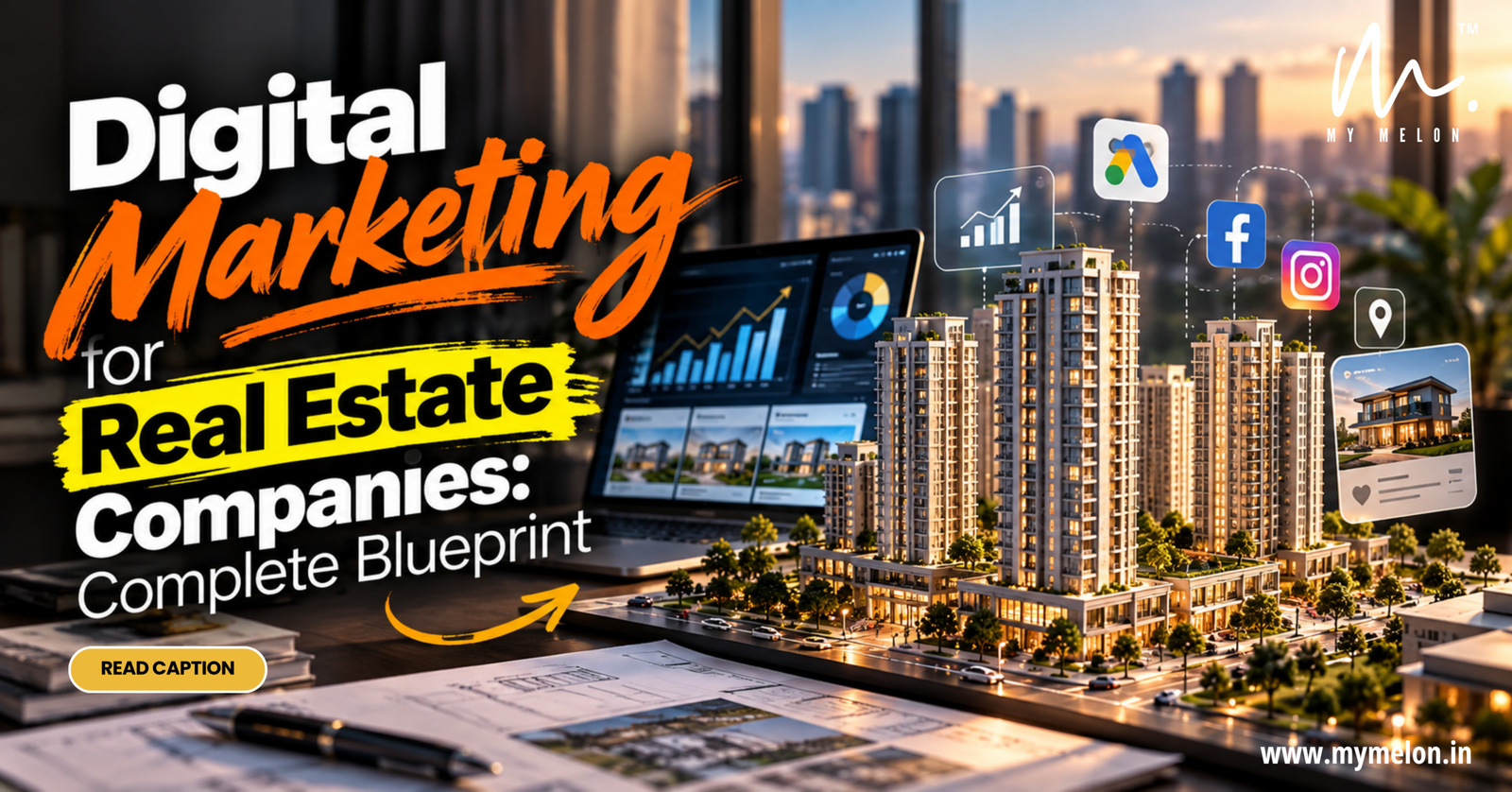
This guide explains how developers, builders, brokers, property consultants, and real estate companies can build a complete digital marketing system that attracts potential buyers and turns attention into qualified enquiries.
Why Digital Marketing Has Become Essential for Real Estate
Real estate is a high-consideration purchase.
Someone might see an advertisement for a T-shirt and purchase it within minutes. Property decisions can take weeks, months, or sometimes longer.
During this period, buyers continuously research.
They may discover a project through Instagram today, search for it on Google tomorrow, watch a YouTube walkthrough a few days later, visit the developer’s website, compare it with three competing projects, discuss it with family, and finally submit an enquiry.
This makes the real estate customer journey complex.
A company focusing only on lead-generation ads sees only one small part of that journey.
An effective real estate digital marketing strategy needs to influence buyers before, during, and after they become a lead.
Understanding the Modern Real Estate Buyer Journey
Before deciding which marketing channels to use, understand how people actually buy property.
A simplified journey may look like:
Need → Research → Discovery → Comparison → Trust → Enquiry → Site Visit → Follow-up → Purchase
Digital marketing can influence almost every stage.
Stage 1: Need
The buyer starts considering a property.
For example:
“Should I invest in Gurgaon?”
“I need a 3 BHK near Noida Expressway.”
“Is commercial property a good investment?”
Stage 2: Research
They start searching for information.
They may search:
- 3 BHK flats in Gurgaon
- Luxury apartments in Noida
- Commercial property investment in Delhi NCR
- Best areas to invest in Gurgaon
- Ready-to-move apartments near Dwarka Expressway
Stage 3: Discovery
Now they discover projects, developers, brokers, consultants, YouTube videos, property portals and advertisements.
Stage 4: Comparison
Price, location, amenities, possession status, connectivity, developer reputation and future potential are compared.
Stage 5: Trust
The buyer wants to know:
“Can I trust these people with such a significant financial decision?”
This is where your website, content, reviews, videos, social presence and brand reputation become extremely important.
Stage 6: Enquiry and Site Visit
Only after sufficient confidence is created does the buyer usually become a serious lead.
This is why generating a form submission is not the real objective.
The real objective is creating enough confidence to move someone from research to conversation and eventually to a site visit.
1. Build a Website That Actually Sells the Opportunity
Many real estate websites look beautiful but fail commercially.
Large banners, architectural renders and animations may make a website visually impressive, but buyers need information.
Every project page should clearly communicate:
Project overview
Explain what the project is and whom it is designed for.
Location
Show connectivity, nearby landmarks, infrastructure, schools, hospitals, business hubs and transportation.
Configuration
Clearly mention available property types, such as 2 BHK, 3 BHK, villas, plots or commercial units.
Pricing
Where commercially possible, provide meaningful pricing information or starting ranges.
Amenities
Don’t simply list amenities. Explain the lifestyle or practical benefit they provide.
Floor plans
Allow serious buyers to understand space planning.
Project gallery
Use quality photographs, renders and walkthroughs.
Developer information
The credibility of the developer significantly affects purchase confidence.
RERA information
Relevant regulatory information should be clearly available.
Calls to action
Make actions such as:
- Request Price
- Download Brochure
- Schedule Site Visit
- Talk to Property Advisor
- Get Floor Plan
easy to find.
Your website should answer most of the buyer’s initial questions before your sales team receives the call.
2. Build an SEO Strategy Around Buyer Intent
Real estate has enormous search demand.
But simply ranking for broad keywords like “property in Delhi” is not a complete SEO strategy.
Real estate SEO should be built around different levels of buyer intent.
Transactional Searches
These indicate stronger purchase intent.
Examples:
- flats for sale in Gurgaon
- 3 BHK apartments in Noida
- commercial property in Gurugram
- luxury apartments in Delhi NCR
- ready-to-move flats in Noida
These keywords should generally connect users with relevant property or location pages.
Location-Based Searches
Location is one of the strongest dimensions of real estate SEO.
Create useful pages around important micro-markets.
For example:
Property in Gurgaon
Then deeper pages such as:
Property on Dwarka Expressway
Apartments in Sector 113 Gurgaon
Luxury Apartments on Golf Course Road
This allows you to capture buyers at different levels of specificity.
Informational Searches
Not everyone searching for property is ready to enquire today.
Someone may search:
Is Dwarka Expressway a good investment?
Best areas to buy property in Gurgaon
Ready-to-move vs under-construction property
Things to check before buying an apartment
These searches create an opportunity to reach buyers earlier.
That’s where content marketing becomes powerful.
3. Don’t Treat Google Ads as Just Another Lead Machine
Google Search Ads can be particularly valuable because they capture existing demand.
Someone searching: “3 BHK apartment in Gurgaon” already has some degree of intent.
Compare that with someone casually scrolling Instagram who sees a property advertisement.
Both audiences can be valuable, but their intent is different.
Google Ads campaigns can therefore be structured around categories such as:
Project campaigns
Target searches related to specific developments.
Location campaigns
Target searches around areas where inventory is available.
Configuration campaigns
Examples include 2 BHK, 3 BHK, villas, plots and office spaces.
Investment-intent campaigns
For investors researching commercial or investment opportunities.
The landing page should also match the advertisement.
If someone searches for a 3 BHK on Dwarka Expressway, sending them to a generic homepage creates unnecessary friction.
Send them directly to the most relevant page.
4. Use Meta Ads to Create and Capture Demand
Instagram and Facebook work differently from Google Search.
People are generally not actively searching for property while scrolling their feeds.
Your creative therefore needs to create interest.
Instead of endlessly running: “Luxury 3 BHK Starting at ₹X Cr. Book Now.”
test different buyer motivations.
For example:
Location-led
10 minutes from a major business hub. Here’s what living here could look like.
Lifestyle-led
Show the actual experience of the project rather than only specifications.
Investment-led
Explain why a particular location is attracting attention.
Problem-led
Paying ₹70,000 rent every month? Here’s what buyers in this area are considering instead.
Property walkthroughs
Let buyers virtually experience the property.
Founder or advisor-led videos
Have someone knowledgeable explain the project instead of relying entirely on polished advertisements.
People often trust people more than promotional graphics.
5. Video Should Be at the Centre of Real Estate Marketing
Few industries benefit from video as naturally as real estate.
Property is visual.
Buyers want to experience:
- Rooms
- Balconies
- Views
- Amenities
- Roads
- Neighbourhoods
- Construction progress
- Sample flats
- Clubhouses
- Commercial spaces
before physically visiting.
Create different video formats rather than producing only cinematic project videos.
Property Walkthroughs
Show what buyers will actually see.
Location Tours
Explain nearby roads, metro connectivity, schools, hospitals and commercial hubs.
Educational Videos
Examples:
3 things to check before investing in Gurgaon
Should you buy ready-to-move or under-construction property?
Project Comparison Videos
Help buyers understand genuine differences between options.
Construction Updates
Regular progress builds confidence among both existing and prospective buyers.
Short-Form Reels
Turn larger property content into Instagram Reels, YouTube Shorts and other short-form content.
One site visit can potentially generate dozens of pieces of content.
6. Build Authority Through Content, Not Just Listings
One of the biggest mistakes in real estate marketing is talking only about inventory.
Buyers don’t only need properties.
They need clarity.
A real estate company can become a trusted source by answering the questions buyers repeatedly ask.
Content topics might include:
- Best locations for property investment
- Home buying checklists
- Financing basics
- RERA-related educational content
- Infrastructure developments
- Locality comparisons
- Residential vs commercial investment
- Rental yield concepts
- Property documentation
- Market trends
- First-time buyer guides
Imagine two property consultants.
One constantly posts:
“2 BHK Available. Call Now.”
The other consistently explains markets, locations, investments, risks, projects and buying decisions.
Who appears more knowledgeable when a buyer is finally ready?
That is the difference between advertising inventory and building authority.
7. Turn Founders and Property Advisors Into Personal Brands
Real estate is ultimately a relationship-driven business.
That makes founder-led marketing especially powerful.
Instead of keeping all communication behind the company logo, let experienced people inside the organisation become visible.
Founders, directors and senior property consultants can share:
- Market observations
- Investment perspectives
- Location insights
- Buyer mistakes
- Project analysis
- Industry changes
- Behind-the-scenes experiences
- Lessons from client conversations
This works especially well on LinkedIn, Instagram and YouTube.
A company can tell people it understands real estate.
A knowledgeable founder demonstrating that expertise repeatedly is far more convincing.
8. Use Local SEO to Capture Nearby Demand
Local search matters especially for brokers, consultants and agencies operating in specific markets.
Your Google Business Profile should be properly maintained with:
- Correct business information
- Relevant categories
- Updated photographs
- Customer reviews
- Regular updates
- Accurate contact details
Reviews deserve particular attention.
Real estate involves significant money and naturally creates anxiety.
Authentic reviews help reduce that uncertainty.
Don’t just collect ratings.
Encourage genuine clients to explain their experience, such as how your team helped them shortlist properties, understand documentation, negotiate, or complete the transaction.
Detailed reviews communicate far more trust than a simple five-star rating.
9. Stop Buying Leads Without Building a Brand
This is one of the biggest traps in real estate marketing.
Companies spend heavily on portals and advertisements, collect thousands of leads and then wonder:
“Why is lead quality so poor?”
Part of the problem is that marketing becomes completely transactional.
The buyer sees an advertisement, submits a form and immediately receives calls.
There is no relationship or brand familiarity.
Brand building changes that equation.
If buyers have already:
- Seen your videos
- Read your content
- Visited your website
- Seen client testimonials
- Watched your founder explain the market
- Encountered your brand repeatedly
the sales conversation begins from a different level of familiarity.
Lead generation creates contacts. Brand building creates preference.
Real estate companies need both.
10. Retarget Interested Buyers
A buyer visiting your website today may not purchase this week.
That doesn’t mean the visit had no value.
Retargeting allows you to remain visible to people who have already interacted with your business.
Audiences might include:
- Website visitors
- Project page visitors
- Video viewers
- Instagram engagers
- Lead-form visitors
- Previous enquiries
But don’t show them the same advertisement repeatedly.
Build a sequence.
First interaction: Introduce the property.
Second interaction: Show a walkthrough.
Third interaction: Explain the location.
Fourth interaction: Show testimonials or credibility.
Fifth interaction: Invite them to schedule a site visit.
This creates a journey rather than repeatedly shouting:
“BOOK NOW!”
11. Connect Marketing With the Sales Team
Real estate marketing does not end when a lead arrives.
In many companies, this is where the biggest leakage begins.
Imagine spending thousands to generate a qualified enquiry and then:
- Calling hours later
- Calling repeatedly without context
- Sending a generic brochure
- Forgetting follow-ups
- Not recording lead sources
- Treating every enquiry identically
Marketing and sales need one connected process.
A CRM can help track:
Lead source → Requirement → Budget → Location → Follow-up → Site Visit → Negotiation → Booking
Marketing teams should also know what happens after lead generation.
Which campaign generated actual site visits?
Which location produced serious buyers?
Which advertisement generated bookings?
Which leads were junk?
Without sales feedback, marketers optimise for cheap leads rather than business outcomes.
12. WhatsApp Can Become a Powerful Nurturing Channel
WhatsApp is already deeply embedded in buyer-salesperson communication.
Use it intelligently.
After an enquiry, buyers can receive relevant information such as:
- Project brochure
- Floor plan
- Location map
- Walkthrough
- Construction update
- Pricing details
- Site visit confirmation
But avoid turning WhatsApp into a constant promotional broadcast.
The communication should help the buyer make a decision.
13. Measure Metrics Beyond Cost Per Lead
A ₹300 lead isn’t necessarily better than a ₹1,000 lead.
Suppose Campaign A generates:
100 leads at ₹300 = ₹30,000
but only two people schedule site visits.
Campaign B generates:
40 leads at ₹800 = ₹32,000
but 12 schedule site visits.
Which campaign is actually performing better?
Real estate marketers should track metrics across the funnel:
Ad Spend → Leads → Qualified Leads → Conversations → Site Visits → Negotiations → Bookings → Revenue
Important metrics include:
- Cost per lead
- Cost per qualified lead
- Lead-to-site-visit rate
- Cost per site visit
- Site-visit-to-booking rate
- Cost per acquisition
- Revenue generated
- Marketing ROI
The cheapest lead rarely tells the complete story.
14. Create a Full-Funnel Real Estate Marketing System
The strongest strategy isn’t Google Ads.
It isn’t Instagram.
It isn’t SEO.
And it isn’t property portals.
It is how these channels work together.
Awareness
Use:
Video
Instagram
YouTube
Founder content
Educational content
Discovery
Use:
SEO
Google Search
Local SEO
Property portals
Consideration
Use:
Website
Project pages
Walkthroughs
Location guides
Testimonials
Case studies
Reviews
Conversion
Use:
Google Ads
Meta Ads
Landing pages
WhatsApp
Lead forms
Site visit booking
Nurturing
Use:
CRM
WhatsApp
Email
Retargeting
Sales follow-ups
Advocacy
Use:
Reviews
Testimonials
Referral programmes
Customer stories
That is when digital marketing stops being a collection of campaigns and becomes a growth system.
Common Digital Marketing Mistakes Real Estate Companies Make
Even companies spending heavily online frequently make fundamental mistakes.
Running only lead-generation campaigns: Leads without brand building usually create excessive dependence on advertising.
Using generic creatives: Stock skyscrapers and “Luxury Living Redefined” rarely create meaningful differentiation.
Sending every visitor to the homepage: Search intent and landing-page content should match.
Ignoring organic visibility: Paid advertising stops when the budget stops. SEO and content can compound over time.
Poor follow-up: Marketing cannot compensate for a broken sales process.
Focusing only on CPL: Cheap leads can become expensive when none convert.
Posting properties without educating buyers: Constant inventory promotion builds little authority.
Ignoring existing leads: Today’s uninterested buyer can become tomorrow’s customer.
What the Future of Real Estate Marketing Looks Like
Real estate marketing is becoming more transparent, visual and buyer-driven.
Buyers increasingly expect to research independently before speaking with sales teams.
AI can make lead qualification, personalisation, content production, CRM workflows and campaign optimisation more efficient.
Virtual tours can make property discovery easier.
Data can help companies understand which buyers deserve greater sales attention.
But technology does not eliminate the fundamentals.
A buyer still needs to believe:
This property is right for me.
I understand what I’m buying.
I trust the company selling it.
The companies that combine technology with credibility, useful information and strong human relationships will be better positioned to compete for buyer attention.
From Selling Properties to Building a Real Estate Brand
A real estate company shouldn’t aim to be visible only when it has inventory to sell.
It should aim to become a brand buyers already recognise when they decide to buy.
That requires moving beyond:
Post → Run Ad → Generate Lead → Call Lead
towards:
Educate → Build Visibility → Create Trust → Generate Demand → Nurture → Convert → Build Relationships
Because buyers aren’t simply choosing between properties anymore.
They are choosing between dozens of developers, brokers, consultants and projects competing for their attention.
The property gets them interested.
The brand gives them confidence.
The experience helps close the deal.
At MyMelon, we help real estate businesses build connected marketing systems that combine strategy, visibility, content, performance marketing and brand building around one objective: business growth.
If your real estate business is generating leads but struggling to turn digital attention into genuine opportunities, perhaps the next campaign isn’t the first thing you need.
Maybe you need a better marketing system.